Tuesday, April 12, 2016

Monday, January 11, 2016
I got a job... and need to update
Well hello hello! It has been embarrassingly long since I last wrote on this blog. I've broken my seven-year stretch! This blog started in 2009 as a way to document a wildlife internship and quickly evolved into a storytelling platform for all wildlife-related positions I've held. I slowed down a bit during graduate school, but now that I'm done with my master's degree I've run out of excuses! I'm at the end of my lunch break so will have to leave you with a link, but I did in fact get a job and I do in fact love it! Until I can write a chapters-long update, here ya go:
Savannah River Ecology Laboratory

Savannah River Ecology Laboratory

Hanging out with a marbled salamander
Wednesday, August 20, 2014
Q&A with Southwest Jaguars
Hello friends!
I've been busy doing lab work and taking a summer class, so I've been a little MIA. As I prepare to update this blog with some recent adventures, please stroll on over to Southwest Jaguars to read the Q&A on my bobcat research and ideas about wildlife conservation!
Imogene Davis Q&A with Southwest Jaguars

I've been busy doing lab work and taking a summer class, so I've been a little MIA. As I prepare to update this blog with some recent adventures, please stroll on over to Southwest Jaguars to read the Q&A on my bobcat research and ideas about wildlife conservation!
Imogene Davis Q&A with Southwest Jaguars
Monday, May 19, 2014
Coolest Emails
A few months back I received an email from someone who had stumbled upon this blog and wanted to know my thoughts on one of the past job positions that I wrote about. I was pleased to see that my documentation of wildlife research was being put to good use and being seen by fellow wildlife professionals.
This morning I received an email from another individual regarding a recent job offer in wildlife research. This person wanted to let me know how informative and interesting the content on this page is and that it helped him during the interview. This person is now bound for an awesome adventure in wildlife research, wahoo!
My posting has declined over the course of graduate school (12 hour lab days just aren't as exciting to write about, unfortunately. Thankfully it's meaningful research), but I'm elated that so many people have encountered this site and found it useful. So, if you are a wildlife professional, pay it forward and make sure the world knows what you're up to! Even if you fall out of a tree, write about it. People like to know these things. You never know when someone will find your musings helpful!

This morning I received an email from another individual regarding a recent job offer in wildlife research. This person wanted to let me know how informative and interesting the content on this page is and that it helped him during the interview. This person is now bound for an awesome adventure in wildlife research, wahoo!
My posting has declined over the course of graduate school (12 hour lab days just aren't as exciting to write about, unfortunately. Thankfully it's meaningful research), but I'm elated that so many people have encountered this site and found it useful. So, if you are a wildlife professional, pay it forward and make sure the world knows what you're up to! Even if you fall out of a tree, write about it. People like to know these things. You never know when someone will find your musings helpful!
A lovely coachwhip (Masticofis flagellum) I caught down in central Texas last week. Isn't he gorgeous? More pics soon from my trip down to Independence Creek Preserve.
Saturday, April 5, 2014
Wildlife Education for Boy Scouts
I had a lovely day today working with members of the West Texas A&M University chapter of The Wildlife Society at a Boy Scouts event focusing on wildlife education. Myself and several other students traveled to a local Boy Scouts campground for a family camping event to talk about several species of wildlife, how to identify them, and why they are important. We had booths on reptiles and amphibians, birds, and mammals, and we were able to share information with the help of recorded bird calls, skins and skulls of several carnivore, ungulate, birds, and amphibians, turtle shells, and two live ambassador snakes. We also talked about track identification skills and how to have respectful wildlife encounters.
The scouts had so much fun! It was encouraging to see what the young boys already knew about wildlife, whether from family experience or direct interaction with wildlife. With almost 100 students visiting our booths throughout the afternoon, it was refreshing and comical to count the times a group of boys yelled "ooooooh!" at one of the booths. Popular items at this event included the two-foot long skull of a Nile crocodile, several of the skins, the bird calls, and the six foot eastern indigo snake. The scouts were respectful, asked interesting questions, and really enjoyed learning about the wildlife in their backyard and in Texas. My favorite bit of the day was showing scouts how to identify animal tracks, particularly the simple ways to distinguish between bobcats, coyotes, gray foxes, and domestic dogs.
Here are a few photo moments from the day:


.JPG)
.JPG)
.JPG)
.JPG)
The scouts had so much fun! It was encouraging to see what the young boys already knew about wildlife, whether from family experience or direct interaction with wildlife. With almost 100 students visiting our booths throughout the afternoon, it was refreshing and comical to count the times a group of boys yelled "ooooooh!" at one of the booths. Popular items at this event included the two-foot long skull of a Nile crocodile, several of the skins, the bird calls, and the six foot eastern indigo snake. The scouts were respectful, asked interesting questions, and really enjoyed learning about the wildlife in their backyard and in Texas. My favorite bit of the day was showing scouts how to identify animal tracks, particularly the simple ways to distinguish between bobcats, coyotes, gray foxes, and domestic dogs.
Here are a few photo moments from the day:
One of our ambassador snakes was a five year old eastern indigo snake, a threatened species that ranges throughout the eastern United States and prefers woodland habitat with burrows and debris piles. Indigos can get up to 8 feet long (this guy is just over 6 feet) and have extremely powerful jaws. Indigo snakes are nonvenomous and this ambassador was very calm with so many Scouts wanting to learn about him. He is the biggest snake I have worked with!
Indigo snakes are all black, with very large scales, though sometimes they express a bit of red coloring under the chin. This guy took a break with wildlife student Korey. Isn't he gorgeous?
Steve is an officer of our chapter of The Wildlife Society and is very knowledgeable about birds. Here is is discussing skull morphology and how it affects diet in bird species. Look how interested these Scouts are!
Scouts were fascinated with the size of the Nile crocodile skull and the tiny size of its brain case. Traci, a fellow wildlife student, and I also talked to them about several turtle species using specimen shells. You can see the shell of a Texas tortoise in the photo as well as the skin of a prairie rattlesnake.
.JPG)
Jessica is one of our snake experts and graciously brought her indigo and king snake to the event. Here she is teaching scouts and adults about the eastern indigo, snake morphology, and how to properly handle snakes.
Mule deer skull. Just chilling.
I loved talking about the different wildlife species on this table. The Scouts really enjoyed being able to "handle" all the different species and view them up close. Caroline is a graduate student in wildlife biology at West Texas A&M and is studying pronghorns. She loves talking about coat adaptations and helping kids identify wildlife species with skins and skulls. Jere is an Eagle Scout who enjoys scout events and education and provided lots of laughs throughout the day.
Michelle is an undergrad who has worked with me in the field trapping mesocarnivores on several occasions. Here she is talking to Scouts about the California King Snake she is holding.
These are just a few photo examples of a really fun day. The comical moment of the day, however, came during my discussion with an 8 year old on bears. He wanted to know what to do if he ever saw one. We talked about backing away and not running, being alert in bear country, and what to do when face to face with an animal. I went over the safety basics and how human responses should be different based on whether the animal is alone, with cubs, or guarding a meal, but it became increasingly difficult to not burst out laughing when we got to the differences between the American black bear and the grizzly bear. For starters, this kid looked like the perfect combination of Macaulay Culkin in "Home Alone" and Ralphie from "A Christmas Story." I say this because it is important to visualize this young man's response when I explained that the grizzly bear's taxonomic name is Ursos arctos horribilis and is so named for his horrible attitude. I explained that while black bears usually run away when you yell at and get "big" with them due to fear, a grizzly bear will usually become angry at such a confrontation and humans are often attacked, sometimes killed, from the physical mauling of such an impressive animal. I described these differences with hand gestures and what I assumed were non-scary smiles, but by the time I was finished, the young Scout was standing rigidly in front of me with ever-growing eyes the size of saucers, his mouth hanging open, with literally no words or response. When I asked him if that answered his question, his eyes got even larger, his draw dropped lower, and the silence went on... and then he suddenly took off as fast as he could in the opposite direction.
I obviously should be a teller of scary stories around campfires. Or a backcountry safety trainer in griz country.
Aside from the child I may or may not have instilled a healthy fear of bears in, it was a really wonderful day and I am so happy we were able to spend time with young ambassadors and supporters of wildlife. We plan to develop more educational content in the future for the Boy Scouts in our area, as the future of wildlife management and conservation depends on the education of young enthusiasts.
Saturday, February 1, 2014
Newspaper Feature!
Hello all! It's been a super busy week. I've been working long hours in the genetics lab preparing for my talk on landscape-mediated genetic structure of bobcats in the Texas Panhandle. It's midnight and I just got home from the lab. I had a brief break waiting for my samples to run, so when it came time to go back to campus I snuck up there in my pajamas and enormous, fluffy pink slippers (my mother gave them to me as a joke for Christmas but DEAR GOD they are so comfortable. I'm not ashamed). I was feeling pretty good about the 200 some reactions I'd run today that I slid down the hall Risky Business style... luckily no one saw me.
Today has been a good day even though 18 of those 200 reactions didn't analyze correctly (Celine Dion's song "My Heart Will Go On" came on the radio as I read the 18 failed reactions and I had a good laugh as a result. Sometimes science doesn't work). I received the link to tomorrow's newspaper feature on my thesis research. A local hunting organization volunteered to interview me on my research at West Texas A&M to solicit participation from local hunters. I rely a lot on hunter willingness to donate tissue samples from harvested animals, and together we can learn new things about wildlife populations and hopefully contribute a piece of the puzzle for effective management and conservation.
To read the fantastic article, click here: Important Work
A big thanks to Fat Boy Outdoors for being willing to interview me on my research!

Today has been a good day even though 18 of those 200 reactions didn't analyze correctly (Celine Dion's song "My Heart Will Go On" came on the radio as I read the 18 failed reactions and I had a good laugh as a result. Sometimes science doesn't work). I received the link to tomorrow's newspaper feature on my thesis research. A local hunting organization volunteered to interview me on my research at West Texas A&M to solicit participation from local hunters. I rely a lot on hunter willingness to donate tissue samples from harvested animals, and together we can learn new things about wildlife populations and hopefully contribute a piece of the puzzle for effective management and conservation.
To read the fantastic article, click here: Important Work
A big thanks to Fat Boy Outdoors for being willing to interview me on my research!
Anesthetized gray fox in Palo Duro Canyon State Park. Citizen contribution enables me to understand how the landscape structures gene flow in gray foxes, coyotes, and bobcats.
Wednesday, January 22, 2014
Busy Busy Busy... and a Bobcat Kitten
Unfortunately, my journey in graduate school has involved a steady decline in the content of this site. I intend to pick up the pace a bit, as I've had a lot of fun the last few months and not shared it. As January is already 2/3 of the way through, my research is over halfway complete and I anticipate completing my master's at the end of 2014!
The last few weeks I have been working long hours in the genetics laboratory to prepare for a talk on bobcat genetic structure. I'm very excited to complete the analysis on this portion of my thesis! To recap, I am examining the genetic structure of carnivores in the Texas Panhandle to determine if the landscape mediates gene flow. I am examining bobcats, coyotes, and gray foxes, but as I have a lot of data, I am only discussing bobcats for this talk. I will hold off on offering my expectations for this data, as I am still in the lab. In the next two weeks, however, I expect t know a little more about ho the landscape structures these populations.
What's the justification or observations for this research? I am studying wide-spread, generalist species- this means that, although these carnivore species exist in lower densities than, say, and ungulate or songbird species, their ability to adapt across habitats combined with their high movements generally means that the population will exhibit a panmictic genetic structure. This simply means that everyone travels far distances and as a result a lot of animals are related despite these distances. However, certain anthropogenic and landscape factors can drive gene flow (movements), and with data to support this, I'm investigating if the geographic features unique to the Texas Panhandle, which is the southern extent of the Great Plains, mediate the movements of these carnivore species. So there ya go! Science!
Life as a graduate student isn't always glamorous, but it is rewarding. Case in point this summer when I and a fellow grad student got a call about a BOBCAT KITTEN. A concerned landowner called the sheriff's station when his dog found a little bobcat kitten wandering around in a field, so I loaded up my supplies at 11:30 at night to go tend to this little guy. We arrived downtown to a very unhappy five-week old bobcat kitten. It's a good thing we were called, because animal control was going to take the cat and most likely the animal would have ended up in captivity (if it survived). Lena is another grad student at West Texas A&M studying bobcat habitat selection and movement of a specific bobcat population, so she was, as always, a dream to share this opportunity with. When we realized that this kitten was in good health, we knew that the landowner had merely discovered an impatient kitten waiting for mom to come home. Oftentimes, what we believe to be abandoned or lost wildlife are simply cases where a parent has "parked" it's young, and our good intentions are actually disrupting a perfectly normal and safe natural process for wildlife. A lot of animals that end up in rehab facilities are cases of unnecessary rescue. For this bobcat kitten, we knew we could get him back home to his mother based on the description the landowner provided; we believed he had merely wandered from his den.
Before we returned him to the site of discovery, we collected some data for my thesis. Because of his small size, anesthetization was not possible, so we wore Kevlar gloves to protect our arms and hands and relied upon animal handling training to safely restrain the little guy. At five weeks, he was tiny but feisty! Here are a few pics of the little fella:


The last few weeks I have been working long hours in the genetics laboratory to prepare for a talk on bobcat genetic structure. I'm very excited to complete the analysis on this portion of my thesis! To recap, I am examining the genetic structure of carnivores in the Texas Panhandle to determine if the landscape mediates gene flow. I am examining bobcats, coyotes, and gray foxes, but as I have a lot of data, I am only discussing bobcats for this talk. I will hold off on offering my expectations for this data, as I am still in the lab. In the next two weeks, however, I expect t know a little more about ho the landscape structures these populations.
What's the justification or observations for this research? I am studying wide-spread, generalist species- this means that, although these carnivore species exist in lower densities than, say, and ungulate or songbird species, their ability to adapt across habitats combined with their high movements generally means that the population will exhibit a panmictic genetic structure. This simply means that everyone travels far distances and as a result a lot of animals are related despite these distances. However, certain anthropogenic and landscape factors can drive gene flow (movements), and with data to support this, I'm investigating if the geographic features unique to the Texas Panhandle, which is the southern extent of the Great Plains, mediate the movements of these carnivore species. So there ya go! Science!
Life as a graduate student isn't always glamorous, but it is rewarding. Case in point this summer when I and a fellow grad student got a call about a BOBCAT KITTEN. A concerned landowner called the sheriff's station when his dog found a little bobcat kitten wandering around in a field, so I loaded up my supplies at 11:30 at night to go tend to this little guy. We arrived downtown to a very unhappy five-week old bobcat kitten. It's a good thing we were called, because animal control was going to take the cat and most likely the animal would have ended up in captivity (if it survived). Lena is another grad student at West Texas A&M studying bobcat habitat selection and movement of a specific bobcat population, so she was, as always, a dream to share this opportunity with. When we realized that this kitten was in good health, we knew that the landowner had merely discovered an impatient kitten waiting for mom to come home. Oftentimes, what we believe to be abandoned or lost wildlife are simply cases where a parent has "parked" it's young, and our good intentions are actually disrupting a perfectly normal and safe natural process for wildlife. A lot of animals that end up in rehab facilities are cases of unnecessary rescue. For this bobcat kitten, we knew we could get him back home to his mother based on the description the landowner provided; we believed he had merely wandered from his den.
Before we returned him to the site of discovery, we collected some data for my thesis. Because of his small size, anesthetization was not possible, so we wore Kevlar gloves to protect our arms and hands and relied upon animal handling training to safely restrain the little guy. At five weeks, he was tiny but feisty! Here are a few pics of the little fella:
These gloves protected us from those claws! You can see how unhappy he is to interact with humans. We didn't handle him long.
Latex gloves protect both human and animal from disease. In this photo I was determining the sex of the kitten while Lena restrained him at the scruff, as a parent would to it's young. We are trained to handle wildlife, and we both have our rabies vaccination.
Very fortunate to have interacted with a bobcat kitten, and even better that we were able to safely return him to his den.
The evening ended with Lena and I driving the kitten back to the property where he was found. The landowner hiked out with us and directed us to the location he was found. After some investigating, Lena and I found what we thought to be his den and safely released him. The kitten seemed to know where he was and scuttled out of sight. Assuming all was well, the bobcat kitten was likely reunited with his mother when she returned to care for him later in the evening.
I am very lucky to have had this experience... I mean seriously, how cute was this little guy?! He should now be almost seven months old, dispersed and in search of or settling into his own territory. In the next two years he should successfully breed and produce kittens of his own... kittens who hopefully aren't keen on exploring an open field at just over a month old (he could have been eaten by a fox, coyotes, or even an owl!). It is always a good idea to research the wildlife in your area so you are able to properly help an animal without hurting the animal or yourself. Familiarizing yourself with the individuals and agencies in your area that are equipped to help wildlife will also ensure that your wildlife stay healthy and free.
For questions on mesocarnivores like bobcats, coyotes, and gray foxes, you can contact me here!
Thursday, August 15, 2013
Dr. Roberta Newbury
One of my closest friends, Dr. Roberta Newbury, was recently interviewed by Southwest Jaguars on her doctoral research on bobcat ecology in northwest Montana. Dr. Newbury's field research was my first introduction to wildlife biology, and she offered me a job back in 2010 when I was not qualified. She is an amazing biologist, quality scientist, and one of the most awesome people you could ever meet! Her appreciation of and wonder for science and nature are both exquisite and relentless, and she and her bobcats have taught me a lot about conservation biology and life. I invite you to have a peek into the philosophy of a great biologist:
Dr. Roberta Newbury: The Red Lynx Biologist
Dr. Roberta Newbury: The Red Lynx Biologist
Friday, May 17, 2013
Genetics, Aggie Style
Since my last post, I've not spent too much time in the field. Rather, I transitioned from the field into the lab as well as focused on my coursework. I took some pretty awesome classes this past semester: conservation biology and wildlife nutritional ecology. I definitely feel like I've got this grad student thing down, what with the sixteen page exams I've been writing. It's great! And, I'm pretty stoked at the 4.0 I've maintained the first year of grad school.
Whoa! I finished my first year of grad school! Awesomesauce!
I love school so much, I opted to spend my spring break doing even more work. Not that any grad student actually gets to take university breaks, but I was excited nonetheless. Last semester, I contacted Dr. Jan Janecka at Texas A&M University. Dr. Janecka is a research professor in the molecular cytogenetics and genomics laboratory within the veterinary research department. He's done a lot of work in population and conservation genetics, but has a particular interest in wild felids. Dr. Janecka was gracious enough to let me spend two weeks in his laboratory working on bobcat genetics in order to help me learn more about the techniques necessary for my thesis. It was a very rewarding experience. I spent most of my time with a visiting Mongolian PhD student, Narka, who is doing similar genetics research on Eurasian lynx (Lynx lynx) in Mongolia. Together we prepared numerous samples for sequencing, attempted to teach language to one another (my Mongolian is really wretched, but his English so much better), and navigated the famous Aggieland. We also showed our field research photos to one another. Dr. Janecka has done extensive research on snow leopards (Panthera uncia) in Mongolia, and Narka has assisted radio-collaring snow leopards, Pallas cats (Otocolobus manul), and lynx. As a result, I am plotting on how I might end up in Mongolia.
I really enjoyed this externship because of the quick learning curve and high expectations. Dr. Janecka will also sit on my thesis committee to further advise me on the genetic component of my research, as he has an affinity for and a lot of experience with bobcat (Lynx rufus) research. I was able to assist him on a current research effort as well as learn about tiger, snow leopard, and Mongolian horse genetics. I focused on techniques relevant to my research questions, using exceptional equipment and learning the what and why and how of microsatellite research. I am very fortunate to have been invited to learn in one of the best labs in the country.


Whoa! I finished my first year of grad school! Awesomesauce!
I love school so much, I opted to spend my spring break doing even more work. Not that any grad student actually gets to take university breaks, but I was excited nonetheless. Last semester, I contacted Dr. Jan Janecka at Texas A&M University. Dr. Janecka is a research professor in the molecular cytogenetics and genomics laboratory within the veterinary research department. He's done a lot of work in population and conservation genetics, but has a particular interest in wild felids. Dr. Janecka was gracious enough to let me spend two weeks in his laboratory working on bobcat genetics in order to help me learn more about the techniques necessary for my thesis. It was a very rewarding experience. I spent most of my time with a visiting Mongolian PhD student, Narka, who is doing similar genetics research on Eurasian lynx (Lynx lynx) in Mongolia. Together we prepared numerous samples for sequencing, attempted to teach language to one another (my Mongolian is really wretched, but his English so much better), and navigated the famous Aggieland. We also showed our field research photos to one another. Dr. Janecka has done extensive research on snow leopards (Panthera uncia) in Mongolia, and Narka has assisted radio-collaring snow leopards, Pallas cats (Otocolobus manul), and lynx. As a result, I am plotting on how I might end up in Mongolia.
I really enjoyed this externship because of the quick learning curve and high expectations. Dr. Janecka will also sit on my thesis committee to further advise me on the genetic component of my research, as he has an affinity for and a lot of experience with bobcat (Lynx rufus) research. I was able to assist him on a current research effort as well as learn about tiger, snow leopard, and Mongolian horse genetics. I focused on techniques relevant to my research questions, using exceptional equipment and learning the what and why and how of microsatellite research. I am very fortunate to have been invited to learn in one of the best labs in the country.

Once I created the serum samples of several bobcats' DNA, I created working dilutions of those samples to be used in sequencing.

Pipetting primers into each sample for the polymerase chain reaction.

Stand back! I'm about to try science!
I didn't catch a photo with my new friend Narka, whom is back in Mongolia and is by now beginning his field research. Like me, he was new to genetics and Dr. Janecka has been most helpful in getting us started. I knew I wanted to work in laboratory research after my internship with the Smithsonian, but I didn't realize I would think genetics equally cool to endocrinology. I gotta say, I'm pretty fascinated with what genetics can teach us.
At the end of my visit, I attended the Ecological Integration Symposium, a conference focusing on the application of ecology in a changing world. Like any good conference, the beer social was hosted at a professor's home and students and professors alike mingled and discussed hobbies and research. I learned a lot about solifugids (camel spiders), other invertebrates, reptiles in South America, and more. A&M also has some very bright students working in marine biology. The plenary talks and session talks covered several taxa, ecoregions, and interesting questions. This was my third research conference, and I'm looking forward to many more. This time next year, I hope to be presenting!
After my two weeks in Aggieland I see what the hype is all about. Its a pretty cool little town. Great research, great people, and great beer (my advisor, Dr. Matlack, knows I like beer with conservation).
This summer I will be working with one of my advisors, Dr. Rocky Ward, preparing my samples and testing my newly purchased primers. I will also be live-trapping for bobcats and gray foxes. I recently caught my first bobcat, so look out for that post!
Dr. Janecka contributed to a really beautiful book on snow leopard research called Snow Leopard: Stories from the Roof of the World. Click the link to check it out!
Saturday, February 16, 2013
Field Efforts
A lot has happened in the past month. We have been so busy! Mark and I started our respective field efforts together in the middle of January, and we've been going non-stop through a combination of field trapping and office slaving. The beginning of the season was darkened with the passing of my Granny, a 91 year old southern aristocrat with a sassy attitude and mischievous smile. We will always miss her feisty nature and love of the country.
Mark and I began the season nonetheless excited about what we might encounter, and it's been a little crazy. In a 16-day trapping effort we've caught five foxes, five raccoons, one skunk, and a few narrow misses with those damn bobcats and ringtails... and at least one feral hog. Those damn, invasive hogs!
It's been an awesome skills test for both of us to recall our experiences with blood drawing. Of course, we both visited the veterinarian who sits on our IACUC committee (the committee that approves our animal-use tactics and ensure we are complying with animal welfare regulations, etc) for a refresher prior to going out in the field. Here is the general breakdown of how things have been going in Palo Duro Canyon State Park:


First trap night! This little Gray Fox (Urocyon cinereoargenteus) was a feisty little lady. She was relatively young, likely in her first year, and easily drawn into our trap with the tasty sardines we use as bait. Gray foxes are really cool little critters, being well adapted to a variety of environments but preferring dense cover to avoid predators (particularly bobcats and coyotes). Gray foxes are omnivores and eat a variety of small rodents, opportunistic meals like roadkill or cached kills from other predators, as well as a lot of plant material and berries. The majority of gray fox scat I have found in this area is primarily composed of cactus berry remains. These little guys don't really live too long in the wild, between 2-4 years, and are adept at climbing trees and dashing about on the cliffs of the canyon. This was my first fox encounter! Mark was super helpful in walking me through the anesthetization process, as it had been a while since I'd last processed wildlife. I love this picture because the fox is kind of 'looking into the future' because of the anesthetic. This photo was snapped after taking morphological measurements and obtaining genetic material. All captures are monitored closely for changes in temperature, heart rate, and respiratory rate. Most procedures take 25 minutes. Animals are not harmed from data collection. Participants even get a free meal! In winter, the extra fat and protein from the sardines can be particularly helpful for these little guys.


Mark and I began the season nonetheless excited about what we might encounter, and it's been a little crazy. In a 16-day trapping effort we've caught five foxes, five raccoons, one skunk, and a few narrow misses with those damn bobcats and ringtails... and at least one feral hog. Those damn, invasive hogs!
It's been an awesome skills test for both of us to recall our experiences with blood drawing. Of course, we both visited the veterinarian who sits on our IACUC committee (the committee that approves our animal-use tactics and ensure we are complying with animal welfare regulations, etc) for a refresher prior to going out in the field. Here is the general breakdown of how things have been going in Palo Duro Canyon State Park:

This was Day 1 when we were setting traps. This little gem is the first of my bobcat traps (photo taken before the masterpiece was actually complete/covered). This was when I was still hopeful that catching those silly cats was going to be [relatively, maybe, oh god hopefully] easy.

First trap night! This little Gray Fox (Urocyon cinereoargenteus) was a feisty little lady. She was relatively young, likely in her first year, and easily drawn into our trap with the tasty sardines we use as bait. Gray foxes are really cool little critters, being well adapted to a variety of environments but preferring dense cover to avoid predators (particularly bobcats and coyotes). Gray foxes are omnivores and eat a variety of small rodents, opportunistic meals like roadkill or cached kills from other predators, as well as a lot of plant material and berries. The majority of gray fox scat I have found in this area is primarily composed of cactus berry remains. These little guys don't really live too long in the wild, between 2-4 years, and are adept at climbing trees and dashing about on the cliffs of the canyon. This was my first fox encounter! Mark was super helpful in walking me through the anesthetization process, as it had been a while since I'd last processed wildlife. I love this picture because the fox is kind of 'looking into the future' because of the anesthetic. This photo was snapped after taking morphological measurements and obtaining genetic material. All captures are monitored closely for changes in temperature, heart rate, and respiratory rate. Most procedures take 25 minutes. Animals are not harmed from data collection. Participants even get a free meal! In winter, the extra fat and protein from the sardines can be particularly helpful for these little guys.

And when you purchase your Gray Fox package with just three easy payments of $64.95, you also get this really nice watch.

Pretty little fox face!

Mark is pulling out delicious sardine fillets to bait a trap for ringtails (we only caught foxes at this one trap, however). You can somewhat reference the cliff we are on based on the background.

Another day, another fox. This day we caught two! The traps were right near one another, and we had both a male and a female in each trap, so we suspect that these two were a mated pair (they were of a similar age). Gray foxes, like a lot of their canid cousins, are monogamous for life. Here, Mark is pictured with the healthy male. We ear tag all processed animals to eliminate re-processing of individuals.

Our good friend and lab mate Lena is doing her thesis work on bobcat anthropogenic structure use. We had a lot of fun doing this work-up together and getting a few good pics with this little guy. We don't always photograph animals because each individual responds to the anesthetic differently. In this photo, the fox appears to be awake, but is in fact sedated. We use eye drops to minimize drying, and we never interact with animals in a way that compromises our safety or their well being.

I traveled to North Carolina for a few days in January to attend a family event, and while I was gone Mark caught a skunk! Here, he shows just how gorgeous (anesthetized) skunks are! He did smell a little funny when I came home, however...

We're really lucky to have volunteer interest in our projects. We're able to have undergraduate students join us in the field for both educational and enjoyable experiences, and everyone is able to learn and share. Clay Rushton is a freshman at West Texas A&M... awesome that he's starting to get in the field early! This little fox was caught in a trap meant for bobcats.

We document all sorts of morphological measurements as well as any new or old injuries. This little gal had an old scratch under her eye, but it didn't make her any less gorgeous!

We monitor temperature, heart rate, and respiratory rate as an assessment of how the animal is responding to the anesthetic. Anesthesia makes temperature regulation a little harder, and in harsh conditions, this can be a problem. It was really cold this day and our little fox needed some assistance in staying warm while under the anesthesia. While this is in no way an emergency, we take it very seriously. The anesthetic we use rarely has serious complications in the species we are studying, but nevertheless Clay got to sit with our fox a bit longer while she was still sedated to help warm her back up (she's in his lap).

Cue the "awwwwww." How adorable is this guy? This was my very first raccoon !He was enormous, I mean absolutely huge. He was twice the size of my house cats and weighed 20 lbs. To give that some perspective, my foxes weight 8-9 lbs. I have always marveled at the dexterity of their 'hands,' and I am so fascinated at what these animals survive out there in the harsh wild. This old guy had a dental infection, unrelated to being trapped, but was still in good health. Another freshman volunteer was also able to experience his first raccoon as we assisted Mark on the work-up of his study animal.
Other incidents not photographed include a feral hog messing with one of my traps (those darn hogs are so destructive), seeing my first feral hog (I ate one in Missouri and got close to some but never actually saw one), and chasing a rooster through a field with Mark. We released a few animals because of the weather a couple of days... the Panhandle is so windy! Some days were just too brutal to try and process an animal that we just let them go. Mark has captured one little raccoon three times already, and I've recaptured one of my foxes. So far we have not trapped bobcats or ringtails, but a grad student saw a bobcat the day after I closed my traps! I'm trying to catch one in particular who hangs around a campground in the park, and naturally she shows up when my traps are closed! Such are the joys of wildlife research.
I'm really excited to broaden my sampling area with the assistance of Texas Parks and Wildlife biologists, and I'm testing out a DNA amplification protocol in the lab. I am planning to get back out in the field at the end of the month. Next week I'll be traveling to Houston with some of my fellow students to attend the annual meeting for the Texas chapter of The Wildlife Society. It's going to be so much fun! Lots of students at West Texas A&M will be presenting their research and I can't wait to learn about the research going on in this state.
I'm also stoked to announce that I'll be spending two weeks in March at a genetics lab at Texas A&M focusing on microsatellite research. The professor I'll be working under has done a lot of amazing research on felids, both nationally and internationally, as well as helped develop the first conservation genetics lab in Bhutan. More updates soon!
Sunday, January 13, 2013
Field Day Prep
ZOMG! Tomorrow is my first field day as a graduate student! I'm so excited. Mark and I will be setting some wildlife traps in hopes of catching a variety of species. It's currently 19F outside and dropping, and with 2" of snow yesterday, it promises to be rather chilly! Now if only I can find my thickest baselayer pants.... no seriously, I've torn the house apart and I can't find them...
Tuesday, January 1, 2013
New Year, New Adventure
It's been an intense few months, and they have passed far more quickly than I realized. My first semester of graduate school came and went in a whirlwind, and I've been busy with fun classes, new friends, and a few adventures.
Primarily, I've been working on the experimental design for my thesis. Ultimately, I've learned what NOT to do in science in terms of creating and implementing an experiment, and it's been super duper cool to sort it all out. In a nutshell, I'll be examining the effects of the landscape on the gene flow of bobcats, gray foxes, and coyotes in the Panhandle of Texas. Specifically, I'll get to look at the escarpment, which is the region of the landscape that separates the High Plains from the Rolling Plains in Texas and is part of the second largest canyon system in the United States. Basically, I'll be sniffing around a mini-Grand Canyon looking for mesocarnivores. I start my field efforts in two weeks, and I can't wait to collect samples for laboratory analysis! I am most excited about seeing wildlife again... I've been in the classroom most of the semester, with the exception of a few test scat transect runs with undergrads. It's going to be a seriously intense field effort because I'll be taking classes at the same time, but Mark and I will be helping one another out.
Mark will be looking at the genetic structure and ecology of ringtails, as well as investigating similar aspects of gene flow in raccoons and skunks. I've only seen a ringtail once, and I have zero problem being his field assistant if that means I get to handle one of those little guys! Mark has a lot more trapping experience than I do, so I'm looking forward to brushing up on my injection skills from undergrad and hopefully becoming super efficient at catching every living animal out there!
Although I've primarily been in the classroom and office this semester, I did manage to sneak in a few more adventures:


We'll be tightening up our schedule for trapping effort next week, and I'll be coming back to civilization most nights, meaning very soon that I will be once again posting cool photos and recounting tales of my glorious mishaps!
I'm currently sitting at my grandmother's kitchen table in North Carolina. Being a tough biologist and all, I opted to not get the flu shot, so I naturally came down with easily the worst flu virus I've ever had. I rang in the new year with NyQuil and saltines (ok, and a little bubbly), but it's gonna be a good one! I really am proud to say that I accomplished my goal to enter graduate school in 2012, and I'm lucky to have been able to design my own project from the ground up based on my own idea. I've already done good things this semester, and I have amazing prospects for spring and summer. As I sit here watching cardinals, the state bird of North Carolina, dance about on the front porch, I'm rejuvenated by and excited for the wildlife I'm sure to encounter this year. And, I got my rabies vaccination, so no one has to worry!
Happy New Year friends!
Primarily, I've been working on the experimental design for my thesis. Ultimately, I've learned what NOT to do in science in terms of creating and implementing an experiment, and it's been super duper cool to sort it all out. In a nutshell, I'll be examining the effects of the landscape on the gene flow of bobcats, gray foxes, and coyotes in the Panhandle of Texas. Specifically, I'll get to look at the escarpment, which is the region of the landscape that separates the High Plains from the Rolling Plains in Texas and is part of the second largest canyon system in the United States. Basically, I'll be sniffing around a mini-Grand Canyon looking for mesocarnivores. I start my field efforts in two weeks, and I can't wait to collect samples for laboratory analysis! I am most excited about seeing wildlife again... I've been in the classroom most of the semester, with the exception of a few test scat transect runs with undergrads. It's going to be a seriously intense field effort because I'll be taking classes at the same time, but Mark and I will be helping one another out.
Mark will be looking at the genetic structure and ecology of ringtails, as well as investigating similar aspects of gene flow in raccoons and skunks. I've only seen a ringtail once, and I have zero problem being his field assistant if that means I get to handle one of those little guys! Mark has a lot more trapping experience than I do, so I'm looking forward to brushing up on my injection skills from undergrad and hopefully becoming super efficient at catching every living animal out there!
Although I've primarily been in the classroom and office this semester, I did manage to sneak in a few more adventures:

Lena Thurmond is another graduate student in my lab, and she's looking at the use of anthropogenic structure in a bobcat population. She let me help out on one of her captures... it's been over a year since I've seen a bobcat, and I was so elated!

A few graduate students and undergrad volunteers with our advisor, Dr. Matlack, and one of Lena's cats. This big male was radio collared for Lena's research. For me, it was really cool to see firsthand the wide-open habitat these cats are navigating- it's a far cry from the montane forests of the northwest US!

I was mildly concerned one morning when an undergrad threw herself out of my moving vehicle, but it was to grab this 4.5 ft long bull snake out of the road. I don't have a lot of experience with snakes, so I was pretty stoked to handle her and not get bitten.

This landscape is just awesome. I'm sitting on top of some huge rocks within Palo Duro Canyon State Park on a morning I took an undergrad out to search for scat. So far, my searches have yielded primarily coyote scat, but here I'm collecting a gray fox sample. Since coyotes are difficult to live-trap, I'll be using scat to extract DNA for that species.

Like I said, this landscape is just amazing! No trees, deep fingers of canyon digging into the earth, crazy dirt formations shooting into the sky, and plentiful wildlife. This was my first "field day" as a grad student on my own project, and these two undergrads were crazy enough to go out with me! They helped me run a road scat transect (because wildlife often travel on roads) and learned about scat and track identification of carnivores.
We'll be tightening up our schedule for trapping effort next week, and I'll be coming back to civilization most nights, meaning very soon that I will be once again posting cool photos and recounting tales of my glorious mishaps!
I'm currently sitting at my grandmother's kitchen table in North Carolina. Being a tough biologist and all, I opted to not get the flu shot, so I naturally came down with easily the worst flu virus I've ever had. I rang in the new year with NyQuil and saltines (ok, and a little bubbly), but it's gonna be a good one! I really am proud to say that I accomplished my goal to enter graduate school in 2012, and I'm lucky to have been able to design my own project from the ground up based on my own idea. I've already done good things this semester, and I have amazing prospects for spring and summer. As I sit here watching cardinals, the state bird of North Carolina, dance about on the front porch, I'm rejuvenated by and excited for the wildlife I'm sure to encounter this year. And, I got my rabies vaccination, so no one has to worry!
Happy New Year friends!
Check my guest blog!
Hey guys!
Earlier this semester I was a guest writer on Buffs Gone Wild, a site run by my advisor, Dr. Ray Matlack. Head on over to his domain and read about my initial thoughts on grad school at West Texas A&M University:
Buffs Gone Wild: Imogene Davis
Earlier this semester I was a guest writer on Buffs Gone Wild, a site run by my advisor, Dr. Ray Matlack. Head on over to his domain and read about my initial thoughts on grad school at West Texas A&M University:
Buffs Gone Wild: Imogene Davis
Friday, September 28, 2012
Amarillo News Channel 10!
This morning I visited the local Amarillo news station with my advisor, Dr. Ray Matlack, to watch him film his weekly educational segment, "West Texas Wild." I got a behind-the-scenes look at the blue screen, the cameras (all taller than me), and I met a few of the news anchors. We hung out all morning comparing wildlife stories and discussing tornadoes with the storm-chasing meteorologist (he is braver than me!). Afterward Ray and I scoped out some waterfowl on a flooded lake; it's been raining all week and numerous species are very pleased with the churned sediment and elevated water levels. Be sure to tune in every Friday morning to learn a little more about wildlife in the Panhandle of Texas, and be on the lookout for more videography and educational films, because Ray and I have plans, and soon I'll be coming to a television near you!


Thursday, September 27, 2012
Sequoia National Forest, Week 1
The end of a run is almost as busy as the beginning of a run. For us, a "run" is classified as a four week period in which Primary Sampling Units, or PSU's (defined in our training book, by the way, as "a unit which is primarily sampled"...), are set and checked once every seven days. Each PSU consists of three stations, and each station has one each of a camera trap, bait, and hair snags, as well as a track plate box to collect the tracks (and hopefully hair) of whomever or whatever decides to enter (or, more commonly, destroy) the box.
The end of Run 1 saw everyone arriving on that Friday sweaty, dirty, and smelly... well, that's not particularly any different from field days all over the world, but the end of a run involves pulling all field sampling material and organizing (organizing?!) data by the end of business, so we were all rushing about. Luckily, we had a week of office work between runs.
The office week included sorting photos ("is that a cow?"), washing track plates, organizing all written data for each PSU, and re-sooting track plates. Our track plates are metal sheets burned with an acetylene torch, the result being a black ash that gets on the paws of an animal and is then pressed onto sticky paper as it walks through the track plate box. I was really excited to learn how to use the torch, as it was highschool the last time I touched one. In learning how to use the torch, I was reminded of our oxyacetylene lesson in highschool in which one of my fellow classmates caught his pants on fire and didn't realize it until the flames were licking up to his thighs. No one was hurt too badly, so I can laugh in hindsight, but the acetylene torch is no joke and a lot of caution goes into sooting track plates.
With trucks cleaned, blisters healed, and new partners, we embarked south into Sequoia National Forest!
For this first week I was assigned SCA volunteer Katy, a really awesome chick with zero fear and an intense love for soccer. We were stationed near an area known as "The Needles." The name comes from the intensity of the granite peaks that cap the landscape. Additionally, the lines on the topographic map are so close together that it looks like needles drew it!


The end of Run 1 saw everyone arriving on that Friday sweaty, dirty, and smelly... well, that's not particularly any different from field days all over the world, but the end of a run involves pulling all field sampling material and organizing (organizing?!) data by the end of business, so we were all rushing about. Luckily, we had a week of office work between runs.
The office week included sorting photos ("is that a cow?"), washing track plates, organizing all written data for each PSU, and re-sooting track plates. Our track plates are metal sheets burned with an acetylene torch, the result being a black ash that gets on the paws of an animal and is then pressed onto sticky paper as it walks through the track plate box. I was really excited to learn how to use the torch, as it was highschool the last time I touched one. In learning how to use the torch, I was reminded of our oxyacetylene lesson in highschool in which one of my fellow classmates caught his pants on fire and didn't realize it until the flames were licking up to his thighs. No one was hurt too badly, so I can laugh in hindsight, but the acetylene torch is no joke and a lot of caution goes into sooting track plates.
With trucks cleaned, blisters healed, and new partners, we embarked south into Sequoia National Forest!
For this first week I was assigned SCA volunteer Katy, a really awesome chick with zero fear and an intense love for soccer. We were stationed near an area known as "The Needles." The name comes from the intensity of the granite peaks that cap the landscape. Additionally, the lines on the topographic map are so close together that it looks like needles drew it!

The Needles
Sequoia is lower elevation that Sierra, and as a result it was HOT. Our first day of sampling was in an area similar to rolling plains in that it was entirely open and the majority of the vegetation was a wheat-like grass (sorry, I don't know the species!). However, it isn't prairie land, so the hills were steep and there were actually a few trees. Because the hike was so long, however, we only got two of the three stations set. On the hike out, Katy saw her first rattlesnake! I tried so hard to get a decent photo, but he was almost five feet long and as thick around as my forearm, so my trekking poles weren't actually long enough for me to be very safe. I did get a decent audio piece, so I will post it later (I have a difficult time with video on this blog domain).

Katy on the hike out from our open site

You can hardly see him, but this picture is a great example of why those rattlers are a good warning. He was HUGE!

I also found a little scorpion
We stayed at a remote little campsite at the center of our PSU's. Unfortunately, every week we returned, someone had left a bunch of garbage in the non-bear-safe containers and some critters had strewn the trash throughout the site. The first two nights of this week, Katy and I shared the site with two other crew members, Brad and Ben. We had an interesting time starting a fire with random kindling (I brought marshmallows) and chasing some curious cows away from our campsite. When Brad and Ben left, however, Katy and I were happy to have the cows as company, because the trash issue meant there was one very curious black bear who circled our campsite every night. We never saw him/her, but the animal made enough noise to convince us that it wasn't a raccoon.
The rest of our week involved my introduction to some pretty intense hikes (because of the way SCA's rotate, Katy was only with me for the install week). While I've always enjoyed a challenge, I don't think I've ever really had a hiking experience that I disliked in any way... until now. Katy and I had one hike that was 1500 m in to the first station, and it took us four hours to get down (yes, very, very down) because the landscape was literally a slide pf pine needles and rock drop-offs. Using the topo map wasn't very helpful because every time we thought we'd hiked up to a ridgeline, it dropped off again. Katy and I get along famously so the days were full of laughs and exploring and enjoying our surroundings as we completed our tasks, but this site was brutal. It could be the yellow jacket nest I stepped on first thing in the morning, or it could be that the hike out- scratch that- up, was one of the most intense I've ever done while working. Before you assume that it's either A) the worst thing in the entire world and that we are just that badass, or B) that is wasn't actually that hard and I'm just whining, remember that we were carrying fifty pounds on our backs! Despite the site being old growth forest and therefore shady, we both went through four liters of water each and were still dehydrated. However, the site was really beautiful... I just never got any pictures of it the entire run because it was so intense.
The third day involved road drops... meaning that the hikes weren't very
far from roads and we didn't have to suit up for all three at once. The
drive out to our first site was easily one of the most beautiful I've
ever seen! We were really in the heart of the Needles on this day. On the early morning drive, we saw several critters, including squirrels, tons of adorable cottontails, and one grey fox.

One cottontail was brave enough to let me lean out of the truck window and snap a few.
Katy and I thought our second hike would be as easy as the first one and that we would probably complete the day an hour earlier than usual. The hike in question was only 317 m from the truck! It was pretty much straight up, but the directions from the crew who did this hike five years ago said to stick to the ridgeline and avoid the brush.
Well.... it wasn't exactly that easy. The brush was everywhere! It was impenetrable. Manzanita is a real pain in the ass- it's similar to the northwest plant called Alder in it's rigidity, satanic nature, and desire to suck you into the earth (I'm only slightly kidding). The "manz" was uphill, sidehill, downhill. It was indeed a slippery slope. Looking at the topo map and comparing it with the written directions and drawings, we decided it would be best to scale some rocks and approach our site from behind. We climbed for about half an hour and dropped into a pretty little stream full of wildflowers:
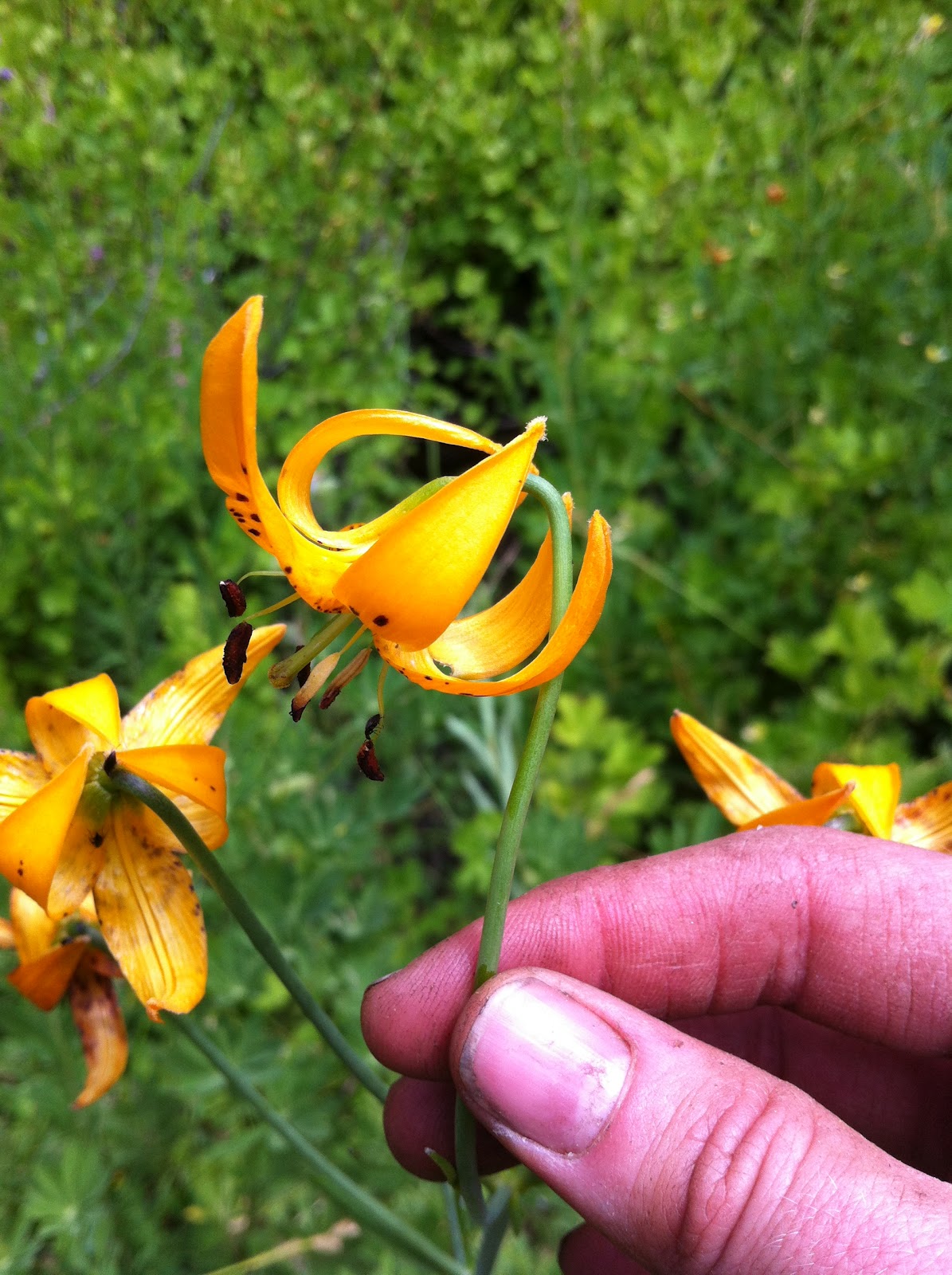

It took us THREE HOURS to hike 300m! THREE! We were not impressed with ourselves, and even less impressed with how overgrown the site was and how difficult it was to swim through the vegetation. But, it is wonderful wildlife habitat, and it if were easy everyone would be doing it!
Day four, by comparison, wasn't that hard at all. We had some longer hikes and a little confusion with abandoned service roads, but since it was a drive out day (that alone takes four hours), the sites had to be a little easier. Because the vegetation changed in the five years since it had last been serviced, however, we were unable to get to one of the locations in time because an old road was so overgrown.

I think this is a juvenile male western tanager. I tried so hard to photograph an adult tanager, but alas!
We had an awesome install week. It was really hard physically, but Sequoia National Forest is SO beautiful. We even saw a few Sequoias (we camped right by the famous Trail of a Hundred Giants). Here are a few landscape photos:

View of the Little Kern River

Nature is so large and we are so small. It's beautiful.

Searching for lizards!

We get paid to work here!

I'm definitely having a "top of the world" moment.
Saturday, July 28, 2012
Mountain Lions!
We just ended our third week in Sequoia National Forest. With many highlights to write about, I must share the most epic of them all:
Yesterday, while hiking back to the truck (the glorious truck that would take us home, since it was the end of the week and we were exhausted), admittedly tuckered out and shuffling, I looked down and stopped short. There in the sand, atop OUR thirty minute old boot tracks, were mountain lion tracks! I asked my partner, Ben, if it was what I thought it was. As we were bent down looking at the track, we noticed several more along the old, reclaimed service road, and heading in the same direction we were heading. Since it had taken us no more than thirty minutes to hike out to our station and start the hike back, the tracks were at the oldest twenty five minutes old. Which meant that we had likely walked right by the cat! We very quickly righted ourselves and looked up and around instead of down at the track. Listening intently around us, we cautiously continued towards the truck, which was about 500 meters away. While we walked, we took note that the great cat was still using the road ahead of us, perhaps very closely ahead of us, and the angry birds and squirrels up ahead confirmed that we were indeed close to the cat. As we walked together, Ben pointed at another set of much larger tracks. There were TWO mountain lions walking the road.
Well shit.
I am a stickler about carrying my bear spray. Anyone who knows me knows that I always carry it (I was taught well by my good friend Bobbie). Bear spray shoots fifteen feet and promises to deter any charging animal from eviscerating you (that is, of course, if you draw faster than they can run. Which isn't always likely.). Stronger than military-grade mace, it will put the largest grizzly bear on his behind and send mountain lions screaming like babies. As my luck would have it, I noticed yesterday morning that the safety trigger on my bear spray had been lost in the field, and I decided to take the spray off my pack for this short, last hike lest I accidentally spray myself . What could possibly go wrong in thirty short minutes on an abandoned service road?
Completely ridiculous.
Armed now with only a rock (which would probably just piss something off even more and make them decorate the nearest fir with my entrails like a holiday tree in retaliation), Ben and I were anxious as we slowly advanced to the truck. In most cases, a black bear will only charge you if defending a cub or a food source. A grizzly bear has a considerably more sour temperament and will do the same thing, but with more unpredictability and often without being provoked. Moose are stupid and angry and not to be trusted. The mountain lion is none of these things, yet all of these things, and probably the most dangerous, as they are silent and will usually only engage with another animal if they are going to kill it. In short, a bear will mock charge you, size you up as a competitor or a threat, but a mountain lion almost always has one thought: can I kill this? With many friends having been stalked by the mountain lion, it is not an encounter I craved on foot. Even as I type, my friends and I are discussing how bear spray is not a competitive weapon against the speed of power of a mountain lion.
And now, almost comically, Ben and I were walking alongside these tracks. We realize we are upwind of the track direction (meaning they couldn't smell us). As I'm about to shout out, make a lot of noise, we suddenly hear a crash around the corner. The crash is very big and very fast and to our right, and very seriously close. Milliseconds later, a second crash echoes to our left. The birds and squirrels are angry. Ben and I freeze like prey, waiting for more sound. Nothing.
The wind had suddenly shifted us downwind of the cats (which in this case was in our favor, but that is not always so...). With this wind change, we startled the two cats and they bolted before our noise could do the same thing. We were only 100 meters from a mother mountain lion and her half-grown cub! With the hair on my neck rising and my senses on overload, we also bolted through the space we last heard sound, making noise and trying to sound big. In doing so, we noticed more tracks, but these ones were pointing in our direction.
The cats were walking right towards us!
When we got to the truck, we reasoned by the tracks that the two cats had walked along the road to our truck (likely drawn to the smell of rotting chicken in the cooler) and had balked at the sight of the vehicle. Turning back, they backtracked their own tracks up the road the way they had come, which was right towards us. We were closing the distance to one another in a very short amount of time. Thankfully, I noticed that first track and we were as ready as we could have been as opposed to what would could have easily been a bad situation as we hiked in exhausted silence. And this all took place in a very short period of time.
One hell of a thrill! I consider myself competent and able in the field, but the laws of nature are simple: let your guard down and you die. Always a chatterbox in the field, I don't think many days pass where wildlife doesn't know exactly where we are, and being ever vigilant in observing our surroundings helps keep us safe. By noticing the faint tracks in the sand, we knew what was there, but being tired probably assisted us in getting close to the cats because of the wind direction and our lack of noise.

Yesterday, while hiking back to the truck (the glorious truck that would take us home, since it was the end of the week and we were exhausted), admittedly tuckered out and shuffling, I looked down and stopped short. There in the sand, atop OUR thirty minute old boot tracks, were mountain lion tracks! I asked my partner, Ben, if it was what I thought it was. As we were bent down looking at the track, we noticed several more along the old, reclaimed service road, and heading in the same direction we were heading. Since it had taken us no more than thirty minutes to hike out to our station and start the hike back, the tracks were at the oldest twenty five minutes old. Which meant that we had likely walked right by the cat! We very quickly righted ourselves and looked up and around instead of down at the track. Listening intently around us, we cautiously continued towards the truck, which was about 500 meters away. While we walked, we took note that the great cat was still using the road ahead of us, perhaps very closely ahead of us, and the angry birds and squirrels up ahead confirmed that we were indeed close to the cat. As we walked together, Ben pointed at another set of much larger tracks. There were TWO mountain lions walking the road.
Well shit.
I am a stickler about carrying my bear spray. Anyone who knows me knows that I always carry it (I was taught well by my good friend Bobbie). Bear spray shoots fifteen feet and promises to deter any charging animal from eviscerating you (that is, of course, if you draw faster than they can run. Which isn't always likely.). Stronger than military-grade mace, it will put the largest grizzly bear on his behind and send mountain lions screaming like babies. As my luck would have it, I noticed yesterday morning that the safety trigger on my bear spray had been lost in the field, and I decided to take the spray off my pack for this short, last hike lest I accidentally spray myself . What could possibly go wrong in thirty short minutes on an abandoned service road?
Completely ridiculous.
Armed now with only a rock (which would probably just piss something off even more and make them decorate the nearest fir with my entrails like a holiday tree in retaliation), Ben and I were anxious as we slowly advanced to the truck. In most cases, a black bear will only charge you if defending a cub or a food source. A grizzly bear has a considerably more sour temperament and will do the same thing, but with more unpredictability and often without being provoked. Moose are stupid and angry and not to be trusted. The mountain lion is none of these things, yet all of these things, and probably the most dangerous, as they are silent and will usually only engage with another animal if they are going to kill it. In short, a bear will mock charge you, size you up as a competitor or a threat, but a mountain lion almost always has one thought: can I kill this? With many friends having been stalked by the mountain lion, it is not an encounter I craved on foot. Even as I type, my friends and I are discussing how bear spray is not a competitive weapon against the speed of power of a mountain lion.
And now, almost comically, Ben and I were walking alongside these tracks. We realize we are upwind of the track direction (meaning they couldn't smell us). As I'm about to shout out, make a lot of noise, we suddenly hear a crash around the corner. The crash is very big and very fast and to our right, and very seriously close. Milliseconds later, a second crash echoes to our left. The birds and squirrels are angry. Ben and I freeze like prey, waiting for more sound. Nothing.
The wind had suddenly shifted us downwind of the cats (which in this case was in our favor, but that is not always so...). With this wind change, we startled the two cats and they bolted before our noise could do the same thing. We were only 100 meters from a mother mountain lion and her half-grown cub! With the hair on my neck rising and my senses on overload, we also bolted through the space we last heard sound, making noise and trying to sound big. In doing so, we noticed more tracks, but these ones were pointing in our direction.
The cats were walking right towards us!
When we got to the truck, we reasoned by the tracks that the two cats had walked along the road to our truck (likely drawn to the smell of rotting chicken in the cooler) and had balked at the sight of the vehicle. Turning back, they backtracked their own tracks up the road the way they had come, which was right towards us. We were closing the distance to one another in a very short amount of time. Thankfully, I noticed that first track and we were as ready as we could have been as opposed to what would could have easily been a bad situation as we hiked in exhausted silence. And this all took place in a very short period of time.
One hell of a thrill! I consider myself competent and able in the field, but the laws of nature are simple: let your guard down and you die. Always a chatterbox in the field, I don't think many days pass where wildlife doesn't know exactly where we are, and being ever vigilant in observing our surroundings helps keep us safe. By noticing the faint tracks in the sand, we knew what was there, but being tired probably assisted us in getting close to the cats because of the wind direction and our lack of noise.

The smaller of the two mountain lion tracks.
A great run in Sequoia! Lots of fishers, hills, bears, and beautiful scenery. And, as we've found, there are a few cougars in the area! More on that later...
Sunday, July 22, 2012
Thought For The Day
“Life should not be a journey to the grave with the intention of
arriving safely in a pretty and well preserved body, but rather to skid
in broadside in a cloud of smoke, thoroughly used up, totally worn out,
and loudly proclaiming 'Wow! What a Ride!'"
― Hunter S. Thompson
― Hunter S. Thompson
Monday, July 9, 2012
Run 1, Or, I'm Tired of Katy Perry
I'm currently taking a break from cooking and packing to spend the month of July camping in Sequoia National Forest for this next run, where things are sure to be a tad more unbridled than the last run. However, the last three weeks involved plenty of adventure as my partner Rachel and I began station checks for mustelids. With half of our stations at higher elevation (7,000 and 9,000 ft) and the other half at 4,500 ft, we had a nice mix of easier vs. more difficult hikes. I finally saw fisher tracks! This is my first experience with fishers ( Martes pennanti), and while I've previously only seen a few marten (Martes americana) tracks, it's been a blast viewing photos of different species at our camera stations. Rachel and I had one set of stations where, every single week, bears would come and steal our bait, and one week a bear grabbed the cord holding our camera to the tree and chewed it off. Another bear was camera shy and slapped the camera to face another direction so he could snack in private. As I mentioned in the last post, I can't share project photos, but I can share the stories... for example, seeing my first wild flying squirrel on camera, or a black bear sow with a very curious cub.
We had one marten who was very angry at the track plate box and flipped it in the process of tearing out the back wire to get at the bait, two weeks in a row. I was surprised that the little weasels have the strength to do so, but I've been assured that they have really bad attitudes (reminds me of bobcats!). Rachel and I were unsure if it was a marten (we found scat at the box) or a bear ripping up the box, as most often the bears are guilty of "womping" the track plate boxes to get the meat inside. To determine the culprit, Rachel and I laid a large log over the box so that a bear could still lift it, but not a 1kg (two pound) marten. Sure enough, when we came back last week, the marten had conceded and entered the track plate box to get his prize rather than tear the box to pieces.
Rachel and I found lots to talk about this last month. Her and I are similar in our ability to talk, quite literally, about anything. We discussed everything from grad school to baking to research projects we'd worked on to why that particular hill totally sucked to... Katy Perry. Actually, we didn't really talk about Katy Perry. Rather, we talked about how we didn't want to talk about Katy Perry. You see, when I was on the bear project last year, I lived with five men in the woods all summer. I learned a lot about what men want in a woman, and I learned a lot about this particular performer. The discussion about how I got tired of hearing about female celebrities stuck, and from then out became a metaphor for which everything we didn't want to do, or hear on the radio, or disliked. While I'm sure this is not the household legacy the singer envisioned for herself, the metaphor became an expletive when faced with a particularly rotten piece of chicken not stolen by a carnivore: "This chicken stinks! Katy Perry!"

Two weeks ago we saw a ringtail run right in front of us on the road! Ringtails (Bassariscus astutus) are mammals in the raccoon family and are sometimes referred to as ringtail cats. Neither raccoon or cat, these little mammals are generalist omnivores, eating whatever is available, from fruits to insects to small mammals. They are adorable!

To my mother's terror, I also saw my first wild rattlesnake! Rachel worked in the Sonoran desert for a year and has a lot of experience with rattlesnakes, so she helped me get as close as possible in attempts to take a photo. Sadly, the little guy was pretty scared, so we opted to leave him alone as opposed to agitate him with the camera. Next time!

While embarking on one extremely miserable route to a station (it took us one hour to hike 200 meters downhill), through brush, burrs, poison oak, and a lot of Katy Perry's, we were rewarded at our wits' end by a very rare encounter. As Rachel barreled through some very nasty vines, I paused a few feet behind to contemplate my next step and catch my breath. Suddenly and silently, I caught movement about six feet in front of me. A screech owl alighted on the branch right in front of me and stared at me very intently. In that moment, I was very happy to be wearing my sunglasses, because she did not look happy with me. I started slightly when heard a rapid clicking and thrashing to my left, and when I turned I was met with two more pairs of yellow moon eyes. Juvenile screech owls! The adult in front of me suddenly took off, likely trying to lure me away from her young, who were obviously learning to fly. One of the fluffy juveniles was comically hanging sideways onto a vine and clicking at me rather angrily. The little bird had apparently tried to fly away and landed in a rather compromising position instead. His wings outstretched, I watched him silently from two feet away, both of us pondering our next move. He decided first and took off, narrowly missing my face and crashing to the ground right at my feet. I wish I had picked him up immediately, but I wasn't sure if it would be too stressful; I wasn't really concerned about the horrible bite I would have received (one of our crew members has worked with owls before and said it wouldn't have been horrible for the bird if I'd helped him out of the vines). Fortunately for the owl, another take-off was all he needed to escape the vines that were limiting his training session, and he flew to the tree above me and perched. The second juvenile regarded me coolly, seemingly unafraid like his sibling and every bit the wise characters of movies, so I moved in with my camera to get photos. By this time Rachel had crept back to take some photos, and I was able to get two feet from the owl for a good snapshot.

Disclosure: I often blast Katy Perry songs on the radio when driving in the field truck with the windows down.
We had one marten who was very angry at the track plate box and flipped it in the process of tearing out the back wire to get at the bait, two weeks in a row. I was surprised that the little weasels have the strength to do so, but I've been assured that they have really bad attitudes (reminds me of bobcats!). Rachel and I were unsure if it was a marten (we found scat at the box) or a bear ripping up the box, as most often the bears are guilty of "womping" the track plate boxes to get the meat inside. To determine the culprit, Rachel and I laid a large log over the box so that a bear could still lift it, but not a 1kg (two pound) marten. Sure enough, when we came back last week, the marten had conceded and entered the track plate box to get his prize rather than tear the box to pieces.
Rachel and I found lots to talk about this last month. Her and I are similar in our ability to talk, quite literally, about anything. We discussed everything from grad school to baking to research projects we'd worked on to why that particular hill totally sucked to... Katy Perry. Actually, we didn't really talk about Katy Perry. Rather, we talked about how we didn't want to talk about Katy Perry. You see, when I was on the bear project last year, I lived with five men in the woods all summer. I learned a lot about what men want in a woman, and I learned a lot about this particular performer. The discussion about how I got tired of hearing about female celebrities stuck, and from then out became a metaphor for which everything we didn't want to do, or hear on the radio, or disliked. While I'm sure this is not the household legacy the singer envisioned for herself, the metaphor became an expletive when faced with a particularly rotten piece of chicken not stolen by a carnivore: "This chicken stinks! Katy Perry!"

Rachel recording data

A ringtail, post-release, from another project last fall here in the Sierras. Photo by M Cancellare

Lower elevation, in rattlesnake territory
While embarking on one extremely miserable route to a station (it took us one hour to hike 200 meters downhill), through brush, burrs, poison oak, and a lot of Katy Perry's, we were rewarded at our wits' end by a very rare encounter. As Rachel barreled through some very nasty vines, I paused a few feet behind to contemplate my next step and catch my breath. Suddenly and silently, I caught movement about six feet in front of me. A screech owl alighted on the branch right in front of me and stared at me very intently. In that moment, I was very happy to be wearing my sunglasses, because she did not look happy with me. I started slightly when heard a rapid clicking and thrashing to my left, and when I turned I was met with two more pairs of yellow moon eyes. Juvenile screech owls! The adult in front of me suddenly took off, likely trying to lure me away from her young, who were obviously learning to fly. One of the fluffy juveniles was comically hanging sideways onto a vine and clicking at me rather angrily. The little bird had apparently tried to fly away and landed in a rather compromising position instead. His wings outstretched, I watched him silently from two feet away, both of us pondering our next move. He decided first and took off, narrowly missing my face and crashing to the ground right at my feet. I wish I had picked him up immediately, but I wasn't sure if it would be too stressful; I wasn't really concerned about the horrible bite I would have received (one of our crew members has worked with owls before and said it wouldn't have been horrible for the bird if I'd helped him out of the vines). Fortunately for the owl, another take-off was all he needed to escape the vines that were limiting his training session, and he flew to the tree above me and perched. The second juvenile regarded me coolly, seemingly unafraid like his sibling and every bit the wise characters of movies, so I moved in with my camera to get photos. By this time Rachel had crept back to take some photos, and I was able to get two feet from the owl for a good snapshot.

Isn't he adorable?!
Well, it's 8:45pm and I'm supposed to be in bed in an hour and I still have tons to pack for camping this week in Sequoia, so I've got to cut this posting short. Katy Perry!
Disclosure: I often blast Katy Perry songs on the radio when driving in the field truck with the windows down.
Subscribe to:
Posts (Atom)